

Raising angel capital in 2026 is very different from a few years ago. Angel investors for startup business opportunities are still active, but founders across many sectors are seeing more investor caution in an increasingly competitive macro-financial environment. Since investors are being more selective, they are far less forgiving of vague storytelling and incomplete diligence documentation.
At The Field Group, we work with founders to help increase their investment opportunities. Many founders have clear ambitions and traction, but the systems, narrative, documentation, and professionalism needed to secure angel investments are lacking.
In this article, we’ll break down how angel investors evaluate startups today, why many rounds stall, and how The Field Group helps founders build a data room and fundraising strategy that converts angel investor interest into committed checks.
For founders seeking angel investors for startup business funding, understanding modern angel investing strategies is critical to standing out in today’s competitive landscape.
Angel Investment Reality Check: Modern Angel Investing Strategies in 2026
Angel investing has matured over the last few years. Today, angels are more experienced, more specialized, more discerning, and more disciplined. They still move faster than traditional institutional funding, but they are far more wary than they were a few years ago.
Across the board, we’re seeing a clear shift in how angels are evaluating founders and startups. Investors are applying far more scrutiny to the fundamentals. They’re digging into unit economics, payback periods, margins, velocity, and repeat behavior.
Additionally, there is greater skepticism around projections built on future scaling. Angels want to see evidence of disciplined execution today – strong financial management, responsible growth, and commercial adoption beyond pilots or early wins. Distribution expansion, larger contracts, and follow-on capital are increasingly tied to demonstrated performance, not just the promise of a dream.
The common thread is clear: vision still matters, but proof and operational discipline matter more. Investors are prioritizing founders who can show that their model is already working and that they know exactly how to scale it responsibly.
These evolving expectations reflect broader business angel investment strategies used by experienced angel investors for start-ups who prioritize disciplined execution over speculative growth.
What Angel Investors for Start-Ups Expect in 2026
Angel investors evaluate early-stage companies through a surprisingly consistent lens. Regardless of sector, they want answers to these questions:
- What big problem are you solving and for whom?
- Does the company have repeat and loyal customers?
- How efficiently does capital convert into growth?
- How will the company use my money, and what milestones does this round unlock?
- How does the founder communicate progress and risk?
- How solid and professional is the team?
Why Angel Rounds Stall
Angel rounds commonly stall for five reasons:
The data room is incomplete or disorganized
Missing financial assumptions, unclear cohort metrics, or outdated documents slow diligence and erode confidence.
The use of funds isn’t milestone-based
Angels want to fund specific risk-reducing milestones, not just “runway”.
The narrative lacks commercial clarity
Strong products aren’t enough if the problem, buyer, and economic impact aren’t well articulated and verifiable.
Operational risks aren’t acknowledged
Supply chain, hiring, or go-to-market (GTM) risks that aren’t highlighted proactively create hesitation and erode confidence.
Founder communication feels reactive
Irregular updates, overly optimistic, or defensive explanations weaken trust.
The Field Group’s angel investing advice exists to eliminate these friction points. We help founders translate traction into clear, validated proof and package it to accelerate investor decision-making. Our experience has taught us that anticipating and preparing a founder for rigorous due diligence is the best way to favorably position a company with an investor.
Why Strong Data Rooms Win Angel Rounds
Naturally, angel investors move more quickly when there’s less uncertainty. A strong data room expedites the process, saving time and energy for all involved.
The benefits of a well-populated data room include:
- Compressing diligence timelines
- Increasing investor confidence
- Signaling the founder’s maturity
- Supporting valuation discussions
- Enabling faster round closures
The Field Group’s Approach to Angel Investments
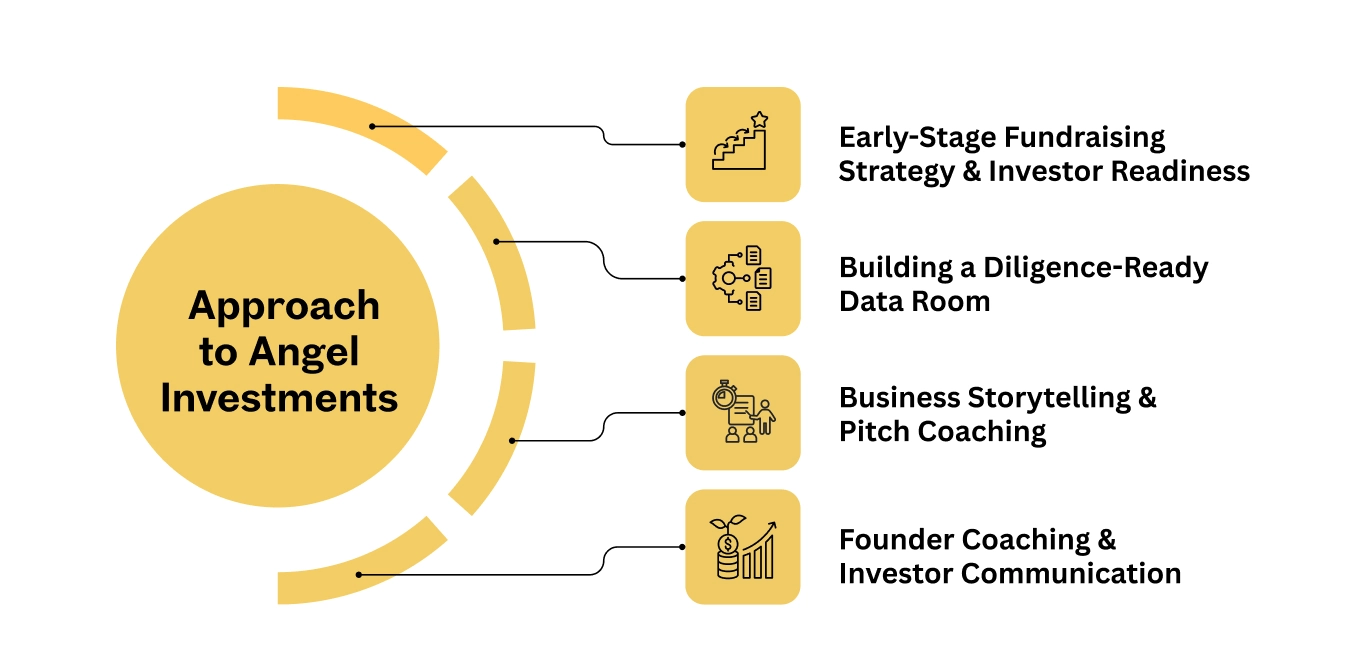
At The Field Group, we treat Data Rooms as strategic assets – tools that shape how angels perceive risk, competence, and upside. The discipline required to win angel investments is the same discipline required to scale responsibly. Founders who build a robust data room and do this work early tend to raise faster, have less dilution, build stronger investor relations, and enter later rounds much more prepared.
Early-Stage Fundraising Strategy & Investor Readiness
The foundation of every successful angel round is a disciplined capital strategy.
At The Field Group, we help founders:
- Right-size the raise based on milestones and realistic valuations
- Align capital deployment to specific proof points that angels recognize
- Explain retention and expansion benchmarks
- Illustrate believable growth projections
- Clearly show an exit strategy that optimizes investor returns
The result is a capital plan that answers the angel’s implicit question: “What will be meaningfully less risky after my check, what is my 'upside' possibility, and when will I get a return on my investment?”
Building a Diligence-Ready Data Room
In this macro financial environment, angel investment flows toward founders who present investor-ready evidence. Therefore, a strong data room is vital to support diligence, while also signaling operational maturity, respect for the process, and the investor’s time.
The Field Group works with founders to build data rooms that are:
- Complete – Financials, assumptions, contracts, metrics, and risk disclosures
- Current – No outdated decks, information, or conflicting numbers
- Navigable – Clear document logic that respects the investor’s time
A typical Field Group-led angel data room includes, but is not limited to:
- Overview - decks and summary
- Company roadmap
- Financial model with transparent assumptions
- Traction dashboards and graphs aligned to the pitch narrative
- Customer proof (case studies, testimonials, pilot results, if appropriate)
- Operational documentation (supply chain, hiring plan, etc.)
- Legal and compliance documentation
- Sales and marketing strategies
- Competitive analysis
- Team bios
- FAQs
When angels open a robust data room, most of their due diligence questions can be answered quickly, shortening cycles and increasing the chance of a successful investment.
Business Storytelling & Pitch Coaching
Even the strongest data won’t convert without the right narrative. The Field Group helps founders craft a pitch that flows logically, avoids exaggeration or under-selling, while clearly communicating why the opportunity matters now.
We structure every story around the three “Ps”:
Problem – What meaningful gap exists in the market?
Proof – What traction, data, or validation demonstrates demand and credibility?
Plan – How will the company scale responsibly and win in the category?
Depending on the space, we refine the storytelling to emphasize what investors care about most, whether that’s consumer behavior, velocity and repeat rates, margins, commercial adoption, operational scalability, or the clear value propositions that differentiate your brand. We make sure your narrative answers the critical question: Why does this company win?
From there, we ensure every element of your materials reinforces that story. This includes:
- Clear messaging aligned with the size and timing of the market opportunity
- Crafting a compelling founder and long-term vision narrative
- Packaging financials and your data room to highlight stability and growth potential
- Pitch deck development and presentation feedback
- Aligning your deck with current business angel investment trends and expectations
Our goal is simple: refine the company’s positioning so it resonates with strategic angels, turning strong fundamentals into investor conviction.
Founder Coaching & Investor Communication
One thing in particular that needs to be emphasized is that angel investors back founders, not just good company models. Angels invest on emotion, assuming everything else aligns, of course. They’re betting on how founders think, communicate, and execute.
That’s why, at The Field Group, we advise and prepare founders as much as we prepare documentation and narrative. We’ve seen many founders fail to secure funding because they came across as defensive, arrogant, or uncoachable.
Some things we emphasize:
- Regular investor updates. Setting up a professional communication cadence signals respect, coachability, and momentum
- Clear articulation of wins, misses, and learnings. Owning mistakes is imperative to show maturity and flexibility.
- Framing pivots as evidence-based decisions
- Specific, actionable asks that invite engagement
- Turning early angels into advocates and referrers
- Communicating with respect and openness

Final Thoughts: Winning Angel Investors for Startup Business Funding
Finding angel investments requires clear evidence, achievable milestones, excellent execution, and professionalism. With greater competition for angel capital, the market has become harder to penetrate; therefore, founders have to be as polished as possible in their presentations.
The Field Group helps founders bridge the gap between early traction and investor commitment by building investor-ready data rooms, sharpening fundraising strategy, and coaching founders to communicate with clarity and confidence.
This preparation significantly improves your credibility with angel investors for startup business opportunities and aligns your raise with proven angel investing strategies.
If you’re preparing for an angel round in the next 60–120 days, now is the time to align your capital plan, narrative, and diligence materials. We’ll help you build a compelling data room, craft a focused fundraising strategy, and lead investor conversations with confidence, giving you the strongest possible position to close the round on your terms.
Frequently Asked Questions
What are angel investors for startup business funding?
Angel investors for startup business funding are high-net-worth individuals who invest their own capital into early-stage companies in exchange for equity, often providing mentorship and strategic guidance alongside funding.
How do angel investors evaluate start-ups?
Angel investors for start-ups typically assess market opportunity, founder capability, traction, unit economics, scalability, and exit potential before committing capital.
What are effective angel investing strategies for founders?
Effective angel investing strategies include targeting the right investors, presenting milestone-based use of funds, demonstrating traction, and preparing a complete, diligence-ready data room.
What are business angel investment strategies?
Business angel investment strategies refer to structured approaches investors use to diversify risk, invest in scalable companies, and align funding with measurable growth milestones.
How much equity do angel investors usually expect?
Equity expectations vary, but angel investors typically seek a stake that reflects the risk and stage of the company, often aligned with valuation, traction, and future growth projections.