Choosing the right leader is one of the most important decisions a business owner makes. For a long time, the choice was very simple: either you used to run the company by yourself, or you hired a dedicated, full-time CEO. However, as the modern economy is shifting towards flexible work hours and people with specialized talent, many business owners are now also opting for a fractional CEO.
At The Field Group, we often see businesses faced with the dilemma of whether to choose a full-time or fractional Chief Executive Officer. If you are a startup founder or a small business owner looking to grow, making this decision can sometimes be challenging.
What are the differences between fractional and full-time leadership, and their role in an organization’s success?
What is a Fractional CEO?
A Fractional Chief Executive Officer is an experienced executive who leads a company on a part-time or contractual basis. Unlike a business consultant, who just offers advice, a fractional CEO provides leadership, strategy, and operational oversight. They have the responsibilities of a traditional CEO, but they work fewer hours than a full-time CEO and typically have their hours already set.
Not sure if it’s the right time? Read Growing or Transitioning? 5 Scenarios in Which a Fractional CEO Is the Right Choice.
Fractional CEO Services
Fractional CEO services are highly customizable. A fractional CEO for small businesses is mostly focused on the critical business functions, such as fundraising preparation, strategic planning, team leadership, and financial restructuring. These part-time CEOs possess specific skills that enable them to identify problems and deliver solutions without needing the extended training time that full-time employees require.
Fractional Chief Executive Officer for Small Businesses
The main challenge facing a growing small business is ‘founder burnout’. Typically, business owners find themselves stuck in day-to-day operations, which prevent them from seeing new areas of opportunity. But after hiring a fractional CEO, owners can dedicate themselves completely to growing their business.

Full-Time CEO: The Traditional Model
Definition & Responsibilities
A full-time CEO is the face of the company. They are deeply immersed in company culture, making all strategic decisions, and reporting to the board and shareholders about the company’s operations and success.
Advantages of Full-Time CEOs
The primary advantage of a full-time CEO is their continued presence. Whether it’s at a time of crisis or celebration, a full-time CEO is a steady face of leadership. They get enough time to develop deep relationships with other employees, and they are completely dedicated to achieving the company’s long-term vision.
Limitations
The biggest limitation that many small to mid-sized businesses face is cost. Assigning a qualified, full-time CEO is extremely expensive because they typically require a six-figure salary, bonuses, benefits, and, often, equity too. Furthermore, hiring a full-time executive can be a time-consuming process.
If you’re comparing executive roles, also read: Fractional CEO vs Interim CEO: Know the Difference Before You Hire for a detailed breakdown.
Fractional CEO vs Full-Time CEO: Comparative Analysis
Cost and Return on Investment (ROI)
Typically, a fractional CEO costs 30% to 40% of a full-time CEO. And because they don’t require a benefits package and long-term severance pay, the return on investment for a fractional CEO is faster. Organizations pay their fractional CEOs based on their approach and results, rather than the hours they spend at their desk.
Flexibility & Scalability
Fractional leadership is very flexible. If an organization is going through a slow time, a fractional CEO’s engagement can be reduced. Likewise, their time can be increased as needed. On the other hand, the services and working hours of a full-time CEO are fixed, regardless of market conditions or needs.
Risk Management
Hiring a fractional CEO for small businesses is an excellent way to assess business operations. It allows organizations to benefit from expert-level leadership without signing any binding contract. If the fractional CEO is not a good fit, then their services can be changed or ended more easily than the more binding contracts of a traditional CEO.
To better understand the role and its business impact, explore What is a Fractional CEO and Why Your Business Might Need One?
Decision Framework, Making the Right Call
Key Question to Ask
To determine which type of CEO will be best for your business, you can ask yourself these questions:
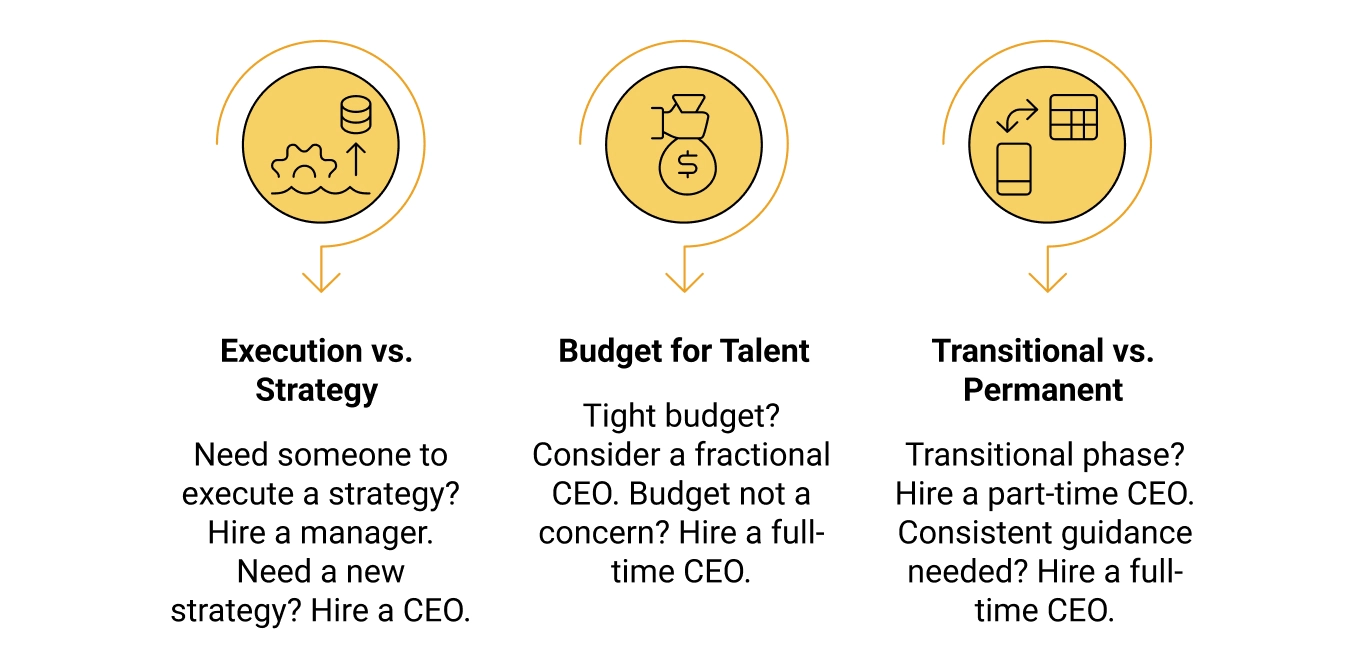
Do we have an execution gap or a leadership gap?
If you have a strategy and just need someone who can work on it full-time, then you need a manager. But if you need a new strategy, then hiring a CEO would be best.
What is our budget for executive talent?
If you have a tight budget, then you can opt for a fractional Chief Executive Officer. But if budget is not a concern for you, then you can hire a full-time CEO.
Is our current challenge a transitional phase or a permanent phase?
If your current phase is transitional, then it would be best to give the executive work to a part-time CEO. But if consistent executive guidance is required, then the services of a full-time CEO would be best.
Industry-Specific Recommendations
Startups that are currently in ‘seed’ or ‘Series A’ stages often benefit more from fractional CEO services because it’s more affordable. However, businesses operating in high-level industries, like finance and healthcare, require the constant oversight of a full-time executive.
Practical Steps
To decide which type of leadership will be best for your organization, define what results and ROI you consider a success. Once you have answered these questions, you should partner with a firm that specializes in executive placement.
This is where The Field Group can help you. We provide experienced Fractional CEOs who can lead and grow startups and small businesses. Our service provides a leader who will work with your team to identify your operational challenges and create a plan for lasting business development. Our practical approach delivers the executive expertise you need without the cost of a full-time executive.
Conclusion: Future of Executive Leadership
Executive leadership is becoming more flexible and accessible. The modern entrepreneur gains a competitive edge because they have more options to hire C-Suite talent.
The Field Group provides support for your executive operational needs. Our Fractional CEO services are designed specifically to empower small business owners and startup founders to step back from daily executive tasks and focus on the bigger picture. The decision to choose fractional leadership allows you to save costs while acquiring the specialized skills needed for your business growth.
FAQs Related to Fractional CEO:
What is the difference between a Fractional CEO and a full-time CEO?
The main difference is commitment and cost. A Fractional CEO works part-time and focuses on strategy and growth, while a full-time CEO manages daily operations and long-term execution. A Fractional CEO is ideal for startups and Small and Medium-sized Enterprises (SMEs) that need expertise without full-time overhead.
What are the advantages of hiring a Fractional CEO?
Key advantages include cost savings, flexible engagement, access to experienced leadership, faster decision-making, and scalable strategy execution without long-term employment risk.
Can a Fractional CEO help with fundraising?
Yes, typically a Fractional CEO can prepare financial strategies, investor pitch decks, and growth plans to support fundraising and venture capital discussions.
What industries benefit most from a Fractional CEO?
Technology, manufacturing, healthcare, SaaS, e-commerce, and growing SMEs commonly benefit from hiring a Fractional CEO.
Is a Fractional CEO a long-term solution?
A Fractional CEO can be a short-term solution for transitional periods or a longer-term solution for businesses that need strategic oversight without full-time executive costs.